Supplication in Islam is not merely spoken words or a ritual to be performed, but a profound act of worship that reveals the true relationship between a servant and his Lord. When a person supplicates, he acknowledges his weakness, his need, and his dependence, and when he raises his hands, he declares that above the heavens is a Generous Lord who hears, sees, and knows. For this reason, Allah Almighty says in the Qur’an: “Call upon Me; I will respond to you.” This verse carries a divine promise that brings peace to the heart and life to the soul, reminding the believer that nothing in his life is beyond the reach of Allah’s mercy and kindness. Supplication is not a replacement for effort; it is the force that pushes a person to take the means while being certain that the results are in Allah’s hands. Whoever combines du‘aa and effort follows the path of the prophets, who were the most persistent in supplication and the most diligent in action.
When we look into the Qur’an, we find that supplication accompanies every great moment. Zakariya (peace be upon him) supplicated secretly, saying: “My Lord, do not leave me alone,” and Allah granted him the glad tidings of a child despite his old age. Yunus (peace be upon him), when he called upon his Lord from the darkness: “There is no god but You; glory be to You,” Allah made his supplication a means of salvation. These stories are not for entertainment; they teach the heart how to return to Allah even when all doors seem closed.
Supplication is not limited to hardship and crises; it is a way of life for the sincere believer. He supplicates in times of ease just as he supplicates in times of difficulty. He asks for guidance and success just as he asks for relief and provision, because he knows that every blessing in his life came by Allah’s power and that its continuation requires gratitude and supplication. The Prophet (peace be upon him) said: “Whoever would like Allah to respond to him during hardship should increase his supplication during times of ease,” teaching us that our relationship with Allah should not be based on temporary need, but on ongoing connection.
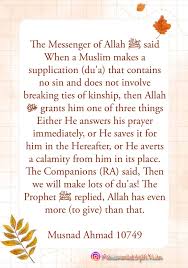
It Is a mistake to think that a delayed response means rejection or disapproval. Allah knows what is best for His servant, giving at the right time and in the right form. He may protect a person from harm he does not know about or save for him a greater good than what he asked for. The Prophet (peace be upon him) said: “There is no Muslim who supplicates with a supplication that does not involve sin or severing family ties except that Allah grants him one of three things: either He answers it immediately, or He stores It for him, or He averts from him an equivalent harm.” A believer never loses certainty in supplication no matter how long the wait, because he knows his Lord is Wise and Merciful and never forgets anyone.
Supplication also has a remarkable effect on refining the soul and purifying the heart. When a person stands before Allah and speaks to Him, tranquility descends upon the heart, and he feels that he is not alone in his struggle with life — that there is a great power supporting and guiding him. The Prophet (peace be upon him) would hasten to prayer and supplication whenever something troubled him, teaching the ummah that turning to Allah is the first and greatest step in facing hardships.
Real supplication is not mere words; it is the presence of the heart, the humility of the soul, and the certainty that Allah hears even the simplest words, accepts despite one’s many sins, and opens doors no matter how complicated reality may appear. Whoever combines supplication, certainty, and effort walks the path of the prophets and the righteous, making du‘aa a light for his journey, a fortress for his heart, and a weapon throughout his life.